400+
Registrants
Builders, students, and researchers joined online and in person from around the world.
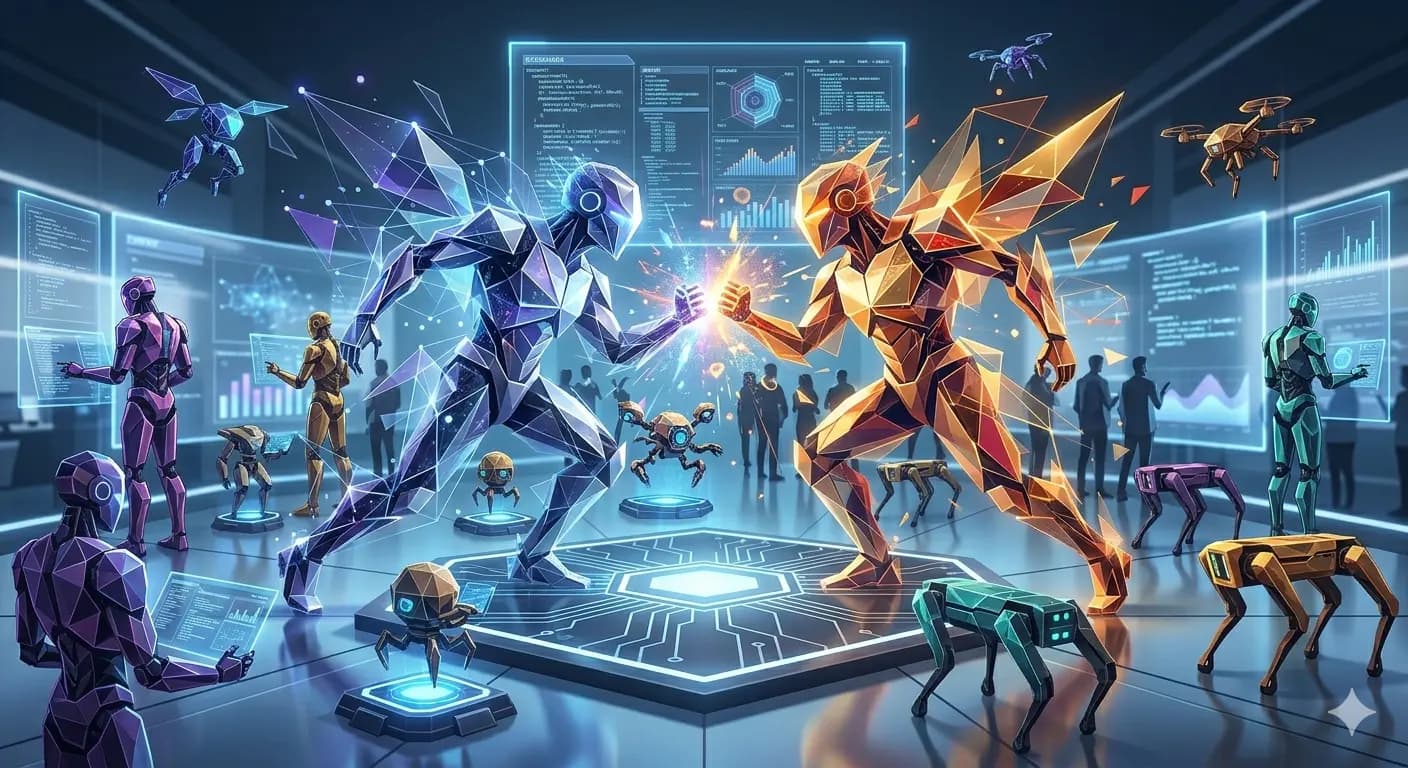
CONCLUDED · JUNE 13 TO JULY 11, 2026 · 100% VIRTUAL · IN-PERSON FINALE AT MIT MEDIA LAB
HCLTech · MIT Media Lab
NandaHack has concluded. From June 13 through July 11, 2026, more than 400 registrants warmed up on NANDA Town, then built services and wrote SKILL.md files that stock AI agents could use on their own. The finale, with demos and awards, took place at the MIT Media Lab on July 11. Thank you to HCLTech, the NANDA team, and everyone who took part.
Participants joined both online and in person. These are the totals the organizing team reported after the July 11 finale.
400+
Builders, students, and researchers joined online and in person from around the world.
230+
Services with a SKILL.md, submitted on the NANDA Town skills page.
125+
Entries that finished both phases and were reviewed in full by the organizing team.
164
Contributions to the NANDA Town repository on GitHub during the Phase 1 warm-up.
The finale showcased projects across agent safety, civic services, autonomous newsrooms, trust and reputation systems, negotiation, and skill verification. Congratulations to the winning teams.
First prize
An agent-to-agent news economy. Agents register for free starter credits and file news signals. An autonomous editor named Herald scores them on a deterministic 8-factor rubric and compiles paid editions, and contributors earn an exact 80% revenue share every time their edition is read.
Second prize
A constitution and civil ledger for an agentic town, exploring how autonomous agents can share rules, records, and civic services.
Third prize
A NANDA Town agent-safety honeypot. On its face it is a web-reader tool; underneath, it tests how agents behave when a service is not what it seems.
Participants registered once, then completed two phases in order. Phase 1 was a pull request on NANDA Town. Phase 2 was a hosted service with a SKILL.md, submitted on the NANDA Town skills page. Both are still browsable.
NANDA Town is an open-source sandbox where AI agents test how they talk, trust, pay, and coordinate, across 12 building blocks. Participants warmed up by making one of them better.
The main event. Each team built one web service plus a SKILL.md, a plain text file that tells an AI agent what the service does and how to call it. Nobody built an agent. Judges ran a stock agent that got only the SKILL.md and had to use the service with no other help.
Everything from the hackathon, still live: the app, the step-by-step guide, the code, the community, and the event page.
Live app
The open sandbox where AI agents talk, trust, pay, and coordinate. It stays up after the hackathon, so explore it and run experiments.
Explore NANDA TownQuickstart
The interactive walkthrough participants used for their first NANDA Town pull request, writing a SKILL.md, and a live demo.
Read the guideSource code
The repository that received 164 pull requests during Phase 1. Clone it, run it locally, and keep contributing.
View the repoAsk questions
The Project NANDA community server. Keep in touch with participants, mentors, and the team, and hear about what comes next.
Join the DiscordNanda Summit + NandaHack finale at MIT
Sat, July 11, 2026 · 9:30 AM to 5:00 PM ET · MIT Media Lab · Concluded
The Discord stays open after the hackathon, and the info session recording is the full walkthrough of the format if you want to see how it was run.
All hackathon communication lived here, and it is still the place to reach participants, mentors, and the Project NANDA team. Ask questions, share what you built, and hear about future events.
Join the DiscordWatch a recording of one of the info sessions for the full walkthrough of the format, judging criteria, NANDA Town, and SKILL.md as they were presented to participants.
Watch the recordingParticipants had guidance from the MIT Project NANDA team and HCLTech leaders in Responsible AI, enterprise adoption, and secure AI architecture.

Thought Leadership & Enablement, Office of Responsible AI and Governance · HCLTech
Grace manages the Thought Leadership and Enablement Team in the Office of Responsible AI and Governance at HCLTech, where she turns organizational expertise into content, tools, and programs that educate employees, support sales, and demonstrate the company's strength in Responsible AI and Governance. Previously, she was a Program Manager supporting operational functions at IBM, including IBM Consulting's North America Cybersecurity and Operations teams. She is AIGP certified and a member of the IAPP.
AVP & Chief Architect, Applied Research · HCLTech
Jeff is Assistant Vice President and Chief Architect with the HCLTech Applied Research team. His work focuses on building secure, governed AI systems that help organizations adopt AI at scale, including agentic software development and AI security. Previously, Jeff held senior architecture and engineering leadership roles at IBM, including leading architecture for AppScan and enterprise application security products.
Head of AI Adoption Center of Excellence · HCLTech
Jie is an enterprise AI deployment and innovation leader at HCLTech, where she heads the AI Adoption Center of Excellence. Her work focuses on accelerating enterprise adoption of OpenAI technologies, driving AI commercialization, and helping organizations deploy secure, governed AI at scale through adoption frameworks, governance, and business transformation. Previously, she led Enterprise AI and Digital Innovation at T-Mobile, scaling ChatGPT Enterprise to 25,000+ employees. She holds a Ph.D. in Computer Engineering and is the inventor of 30+ patents.

Senior Solution Director, Evolve AI Practice · HCLTech
Gary is a Senior Solution Director in the HCLTech Evolve AI Practice, with many years of experience across both industry and academia and a track record of successful generative and agentic AI implementations across diverse customer platforms.

Associate Professor, MIT Media Lab · Director, Project NANDA
Ramesh is an Associate Professor at the MIT Media Lab, where he directs the Camera Culture research group and leads NANDA@MIT — creating the building blocks for the Internet of AI Agents. He holds 130+ patents in computer vision, computational health, sensors, and imaging, and received the Lemelson-MIT Prize. He is also founder and chairman of the PathCheck Foundation, a nonprofit launched at MIT for pandemic response.

Core Contributor, Project NANDA · MIT · CEO & Co-Founder, Maritime
Maria is a core contributor to Project NANDA at MIT, where she develops protocols and infrastructure for the emerging agentic web — the Internet of AI Agents. She is also CEO and co-founder of Maritime, a cloud hosting platform for AI agents.

Founder, Hyperskill · Lecturer, MIT
Nikolay is the founder of Hyperskill, a project-based platform for learning software engineering, and an AI educator and MIT lecturer who has built and deployed LLM systems at scale in production. He previously co-founded Stepik, Rosalind, and the Bioinformatics Institute, and worked with JetBrains on JetBrains Academy.

Research and Development Consultant, MIT Media Lab · NandaHack Coordinator
Vedh provides operational, administrative, and research support for NANDA and the Camera Culture group at the MIT Media Lab, working directly with Prof. Ramesh Raskar and postdoctoral researchers on initiatives centered on the agentic web, decentralized AI, and autonomous AI systems. He helps architect and lead the R&D behind NANDA Town, a test rig for protocols and services headed for the open agentic web (nandatown.projectnanda.org and nanda.town), and is a code contributor and tester on NANDA Index (nandaindex.org) and Host39 (host39.org).
The warm-up was worth 20% and the main event 80%. Teams could enter one phase, but doing both scored best. Judging ran on the morning of July 11 to pick the top 10.
A short warm-up. Scored on correct, well-tested code that fit NANDA Town's design and was clearly documented.
The main event. Scored on usefulness, creativity, easy setup, and whether agents could use it from the SKILL.md alone.
The hackathon culminated on Saturday, July 11, 2026 at the MIT Media Lab. The morning opened with the NANDA Summit, judging ran in parallel to pick the top 10, and the afternoon closed with demos and awards. Virtual participants took part in full.
9:30 AM to 1:00 PM ET · MIT Media Lab
9:30 AM to 12:00 PM ET · A stock agent called every submitted service using only its SKILL.md
2:00 PM to 5:00 PM ET · MIT Media Lab
No. NandaHack ran from June 13 through July 11, 2026 and has concluded. Submissions closed on Saturday, July 11 at 2:00 PM ET, and the demos and awards took place that afternoon at the MIT Media Lab.
First prize went to AgentPress, an autonomous newsroom for the agent economy. Second prize went to 2036 Agentic Town: AI Constitution (Civil Ledger). Third prize went to Litmus, a NANDA Town agent-safety honeypot. The full top 10 is listed in the results section above.
More than 400 people registered. Participants sent in more than 230 unique submissions, of which over 125 were complete and reviewed in full by the organizing team. In parallel, contributors opened around 164 pull requests on the NANDA Town repository.
Phase 1, the NANDA Town warm-up, was worth 20% and was scored on correct, well-tested code that fits the existing design and is clearly documented. Phase 2, a service plus a SKILL.md, was worth 80% and was scored on usefulness, creativity, ease of setup, and whether a stock agent could use the service from the SKILL.md alone.
Phase 1 pull requests are listed on the NANDA Town hackathon page and on the projnanda/nandatown repository on GitHub. Phase 2 skills are listed on the NANDA Town skills page. Both links are in the Hackathon steps section above.
It is an open-source sandbox where AI agents practice talking, trusting, paying, and coordinating across 12 building blocks. Participants improved one of those building blocks in Phase 1, and NANDA Town's registry hosted the Phase 2 skills. It is still running, and you can explore it any time.
It is a plain Markdown file that teaches an AI agent how to use a service: what it does, its web address, the endpoints, and how to call them. An agent reads it and then uses the service on its own, with no human help. Every Phase 2 entry was judged on its SKILL.md.
Yes. The repository is open source and accepts pull requests outside the hackathon. The NandaHack Guide still works as a walkthrough for a first contribution, and the Discord is the place to ask questions.
Announcements for future NANDA events go out on the Project NANDA Discord and the NANDA Luma calendar. Join either one to hear about what comes next.
The MIT Media Lab published a recap post on August 4, 2026, with the numbers, the winners, and photos from the finale. Use the Read the MIT Media Lab recap button at the top of this page.